I received this testimonial recently, and it’s too good to not share:
“There are lots of artists who can draw pretty pictures, but it’s rare indeed to fin an artist who can listen to me talk about myself and my business and the way I want my clients to FEEL when they work with me. you allowed me to free-associate with words and images, and from that stream of consciousness you have created an image that perfectly captures, not just the work I do, but WHY I do this particular work. With warmth, humor, and humanity”.
For me, these are qualities that I take for granted, so I consider myself lucky that, not only did Elizabeth “get it”, but that she took the time to put it into words. It seems to me that the above describes why I do what my work, and consider my illustrations to be collaborations between me and my clients.


I’ve always been interested in not only combining words and pictures, which illustration essentially is, but finding ways to integrated the two as integrally as possible. Here is one such case, where the nose and eye of this woman becomes the “S” in the word “surly”……in doing illustrations for my friend’s journal pages and poems, I was given the freedom to experiment in this manner of combining words and images, and experimented with layouts too. The final results being the most original work I’ve done, inspired by wonderful, highly personal poems. letter integrated with illustration

While I’m far from expert at Photoshop, and still much prefer to do it all by hand, there is one feature that I’ve found to be invaluable for cleaning up the art, which is the clone stamp tool…..here are two details one before and one after cleaning up….since I am able to enlarge a given image some 500% on the screen and do the cleaning up on a pixel by pixel level, I can truly clean the art, and overall it appears far sharper to the eye, even if some of what I’ve done is so miniscule as to easily be overlooked…..the work is slow, and sometimes tedious, but worth it.

About 5 years ago, I was privileged with the task of taking some 35 of Val’s journal poems, and illustrating them. Since she is open to ideas and loves cartoon art, it was a creative marriage made in heaven, and I did some of my best work. Not only was her writing inspiring in its cadence, style, and content, but I found interesting ways to integrate words and pictures, sometimes turning a letter of a word into a small illustration.
Since then, the art stayed here, as Val busied herself with lots of other activities, but recently she asked me to resurrect them, and get them ready for reproduction. When I got a larger scanner, I was in business. Each page was scanned at 300 dpi, and then I went in on each page, enlarging them on the monitor some 400%, and getting rid of any stray pencil marks, dirt, or paint that went over a line. Moreover, I was seeing the art a bit differently, and began to change some of the values of the art, knocking back details that I felt competed with the words. Overall, what I may have sacrificed in sharp contrast was more than made up for in subtlety and new clarity.
While I thought I was merely going to scan and clean up the art, what I didn’t take into account was that 5 years later, I had changed enough so that I wanted to change the art too. Also, in going back to it, I remembered what fine work the collaboration is, and I’m really happy that it’s finally going to see the light of day.
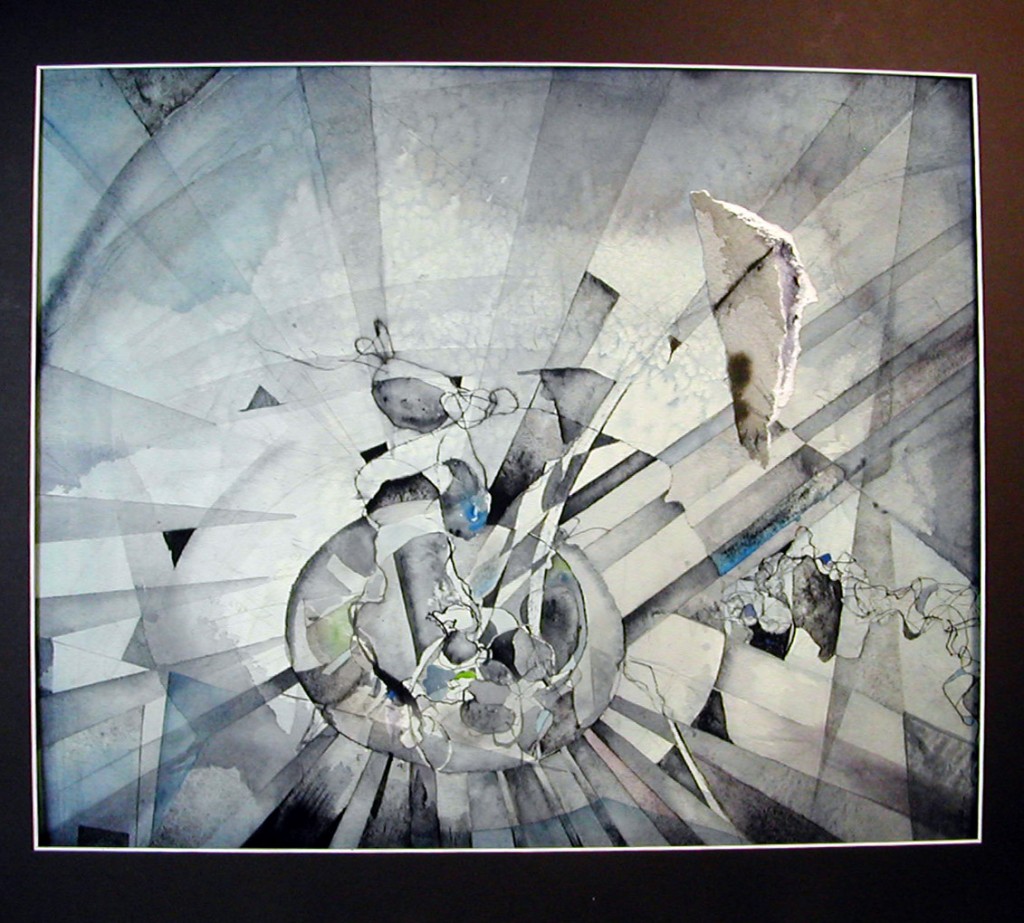
a work in progress
The Payne’s gray color emulates the tonal palette of black and white photography, which was my big influence in this case, from watching 1930s movies on TV as a child.

My autobiographical comic strip didn’t start out to be such. It grew organically from that “POW!” center section of Barney Google getting a fist in his face, which came from a very beat up 1924 Sunday comic section. It was only then that I asked myself, “What has had that “POW affect” on me?”, and the answer was “when I first saw comic book and comic strip art.
Then I began the narrative in the upper left, but wanted to keep the format fluid, so I have characters in different sizes moving from one panel overlapping to the next, and used depth, especially in the upper right corner panel, that shows 7 year old me flying over a geometric field of comic strip panels vanishing into the horizon. Lastly, I go back and forth from a child to an adult twice, adding to the expanse of time. (there’s also a reference to 21st century, of which this style of art is decidedly not)
All the memories are true, and I think that shows. Having my parents holding me back was a throwaway to fill up a small space, or so I thought, only to realize that for me it was the psychologically most complex part.
The piece is a collage, using the yellowed newspaper to visually tie things together (it amazed me how well this old paper held up to paste and water color!). I also used my polka-dot blue pajamas as a repeat motif to visually add cohesion. But, the eye keeps going back to “POW!” and the green burst around it, as those are the most intense colors on the page and the basic idea.
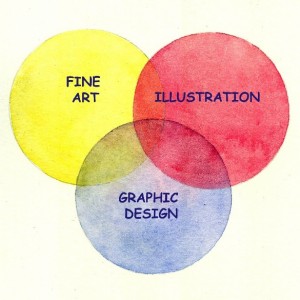 Because I’ve been a full time illustrator for 30 years, I’m always surprised when people confuse illustration with graphic design and “fine art” with, what, “not –so-fine art?”
Here is my explanation. Picture three rings that intersect and overlap one another in the middle, with each of those rings representing one of the following categories-illustration, graphic design, and “fine art.” Each one is an entity unto itself, and yet they have common areas. There are plenty of examples of one piece of art being all three at once, with the caveat being that the term, “fine art,” is subjective. I’m a fan of all three.
Illustration is what I do. I create images by drawing and painting them in ink and watercolor. While my work is done entirely by hand in “traditional media,” perfectly valid illustrations may be computer generated. Regardless of the medium, illustrations are images usually created to highlight something that is written first. The image is illustrating the written word, and bringing more attention to that message than if it was simply a written word.
When that illustration is combined with typography, as in a poster or advertisement, we’re in the category of graphic design. Graphic design normally involves words, layout, and combining those with images. Logos are usually considered graphic design, even if there are aspects of illustration in them. Those aspects are stylized and hard edged enough to blend in with the lettering, and this type of work is mostly done on a computer. I have hand drawn some logos, and those fall right in between the two categories.
The purpose of illustration is specific, as is that of graphic design, and, to put it loosely, they are advertising something, be it a product or an idea. A client, either individual or business, hires the person creating the illustration, or design. The artist knows that he/she will be paid, usually receiving a down payment to begin.
Fine art is art that is created by and for the artist. It can be anything the artist feels like doing at that moment. It may be representational. It may be abstract. Its intentions are to be “art for art’s sake,” and, after completion, the artist will try to sell it. Many aspects of illustration and graphic design, such as composition, use of color, texture, shadow, and subject, are also parts of fine art, and that is where the three categories intersect.
Lastly, an anecdote: many years ago, fresh out of college, I was chatting with two artist types who both did abstract work. I was already clearly more of a cartoon/illustrator. One of them said, “of course you know that our art is higher than yours,” to which I expressed strong disagreement. Some twenty years later, I was visiting people back home, and this artist happened to get wind of my presence. He found out where I was staying, came over, and apologized.
While snobbery may help in the world of art sales, I have no need for it. The lines are too blurred, and there is too much subjectivity and personal taste involved. Illustration is not a higher art form than graphic design nor is abstract art higher than illustration. Each form has its place in our culture and media.

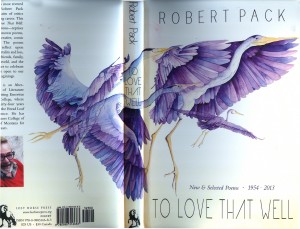
Blue Herons for Robert Pack's poetry book on Lost Horse Press

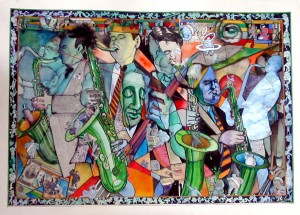 On the power of persistence: I have an affirmation that I am a “great, warrior artist”. When I tell myself I’m a great artist, that negates the possibility of my denigrating the quality of my own work. When I say I’m a warrior, it means I keep persisting without any whining. No whining allowed!
In the case of “Michellin Pop”, I am pleased witht he art on many levels, AND I blew it on the squared edges: they are distinctly off. The framer and I have tried a number of solutions, and today, when I thought we finally had it licked, (this was attempt #4!), it turned out that the framer’s assistant matted the art far too tightly, covering up small portions of the edges. I don’t know what he was thinking, but once again, this piece will stay at the framers for a while until it comes out as right as it can be, considering that it once had off kilter edges that have been straightened out in a way. The whole thing will still be “off” a bit, but in this case, that’s not so bad, and the square edges will conform to the mat, and all in all will have a clean look, which is what I feel the art needs, as opposed to “floating it” with no mat, and showing the deckled edges of the watercolor paper. Whew!
The warrior persists, and abides!

Follow Me

